
Nancy Turner's book Earth's Blanket stirs a soup full of sadness, stories, and realization on the importance of human connection to nature and our duty to preserve Mother Earth.
The Nlaka' pmx people had a tremendous amount of respect towards the Earth. They understood that the Earth offered valuables such as food and it was important to respect and preserve the vegetation and land.
 During and after our lab visit to Secwepemc Museum in Kamloops, I was blown away with how connected the First Nations people were with the land. Even now, those practices and beliefs that have been passed down continue to live on in the First Nations people. I was curious to hear that our tour guide (a Secwepemec woman) would go to the mountains to pick berries; however, before she would take from the Earth, she would give an offering in thanks for what the Earth would be giving her. These people are so pure in heart.
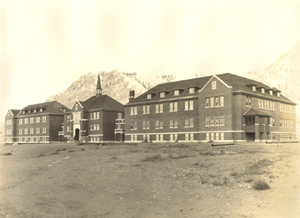
I remember walking past the old residential school towards the parking lot after our tour, the building is absolutely stunning, but it sheds horror and sadness. You can almost hear the Native children in the walls and see their sorrowful faces through the old windows, begging to go home. I am ashamed. I am ashamed that this Country has ruined our First Nations people. I often wonder what this Country would be like if we were not so corrupt and selfish.
The Nlaka'pmx people underwent a lot of change when Europeans took over, they learned that everything was about profit and utilizing the land efficiently. What did these Nlaka'pmx workers think when they saw that their land were being utilized European style? They were adaptive people but this dramatic change caused them anguish and confusion (23). The Native people did all they could to give back to the land when they needed resources, and all of a sudden they were cutting down trees. You can imagine what they had to go through because of their connection to mother nature (23).
I am going to say that Defining Wealth was one of my favorite sections in this reading.
"I believe that wealth-real wealth-is found among people who have a sound sense of their place in the world, who link their actions and thoughts with those of others and who are strong, vigorous and co-operative actors in their communities and ecosystems" (24)
This quote is really meaningful to me, because it holds a lot of truth to it. It sparks motivation to become a better individual in society. The Earth's Blanket metaphor compels people to consider what is valuable to Earth and to link Earth's wealth and important possessions, such as the flowers, grass and other vegetation (24).
Bitterroot, cow parsip, prickly pear cactus, fish and deer are some examples of resources that the Nlaka'pmx people of the region surrounding Spences Bridge used to sustain themselves. They did so with great care and with respect and appreciation (34). They sought to maintain and enhance the species they used, so that there would always be enough for themselves and those who were to come (34). I shake my head at the thought of the European settlers travelling through what is now "The Canyon, or #1" looking at the Nlaka'pmx region and thinking of it as stark and barren. These settlers were focused on only their vision of what this landscape should and could be (34). These settlers churned up the soil and removed the entire constellation of life forms existing in a place to substitute another (34). As a consequence, bitterroot is scarce in the region. Another culturally important form of vegetation gone.
This piece is so spine shattering, it makes you pause for a few minutes and think about how the"white man" tore these First Nations people from their intricate relationship to nature, forcing them against the cultural rules and beliefs they live by. An indigenous leader by the name of Simohalla once said: "You ask me to plow the ground! Shall I take a knife and tear my mother's bosom? You ask me to dig for stone. Shall I dig under her skin for her bones? Then when I die I cannot enter her body to be born again. You ask me to cut grass and make hay and sell it. And be rich like the white men. But how dare I cut off my mother's hair? (38). These metaphors are elements of the complex beliefs that determine the influences humans have on their lands and on other life forms (39).
Turner mentions that change is always to be expected because it is part of natural processes (144). However, abrupt change will not allow species and cultures to adapt, and as a consequence human health will suffer (144). Instead of destroying nature, we have to find ways of conserving what we have and care for the environment.
Bitterroot, cow parsip, prickly pear cactus, fish and deer are some examples of resources that the Nlaka'pmx people of the region surrounding Spences Bridge used to sustain themselves. They did so with great care and with respect and appreciation (34). They sought to maintain and enhance the species they used, so that there would always be enough for themselves and those who were to come (34). I shake my head at the thought of the European settlers travelling through what is now "The Canyon, or #1" looking at the Nlaka'pmx region and thinking of it as stark and barren. These settlers were focused on only their vision of what this landscape should and could be (34). These settlers churned up the soil and removed the entire constellation of life forms existing in a place to substitute another (34). As a consequence, bitterroot is scarce in the region. Another culturally important form of vegetation gone.
This piece is so spine shattering, it makes you pause for a few minutes and think about how the"white man" tore these First Nations people from their intricate relationship to nature, forcing them against the cultural rules and beliefs they live by. An indigenous leader by the name of Simohalla once said: "You ask me to plow the ground! Shall I take a knife and tear my mother's bosom? You ask me to dig for stone. Shall I dig under her skin for her bones? Then when I die I cannot enter her body to be born again. You ask me to cut grass and make hay and sell it. And be rich like the white men. But how dare I cut off my mother's hair? (38). These metaphors are elements of the complex beliefs that determine the influences humans have on their lands and on other life forms (39).
Turner mentions that change is always to be expected because it is part of natural processes (144). However, abrupt change will not allow species and cultures to adapt, and as a consequence human health will suffer (144). Instead of destroying nature, we have to find ways of conserving what we have and care for the environment.
References:
- Turner, N. J. (2005). The earth's blanket: Traditional teachings for sustainable living. Vancouver, BC: Douglas & McIntyre.
Kamloops Residential school: https://royalbcmuseum.bc.ca/exhibits/tbird-park/html/present/expand.htm
Nlaka'pmx people: https://www.pinterest.co.uk/pin/471470654732146263/
Comments
Post a Comment