https://news.nationalgeographic.com/content/dam/news/2015/04/29/booktalkseeds/1_booktalkseeds_nationalgeographic_1004122.ngsversion.1430424000613.adapt.1900.1.jpg

The frustration of nut cracking is real. I enjoyed the imagery Hanson gave when he described his
unsuccessful attempt to split open a seed in his office, and his description of the professor who stormed in, angry with the noise. I found it funny that after all the ruckus he created, a spark of interest grabbed his attention: "why would a seed's shell be so impossibly hard to split? (xx). It is amazing that plant seeds have evolved to be so hardy. Seeds have made an impact in the history of human kind. as Hanson mentions, Homo sapiens may have not evolved if we had no seeds. why? They paved the way to modern civilization, with food, economies, and lifestyle around the world (xxii).
Seeds nourish, unite, endure, defend and travel. Seeds are and integral part of the world (xxv). They are all around us and play an important role in the survival of most all species on this planet.
The first chapter of this book is seriously engaging. I love how we get to walk in the jungle, experiencing Hanson's senses. We have the opportunity to dive into his mind and grasp all of his questions about seeds. Which brings us to the avocado, the humongous seed that shows every detail of germination at close up. The baby plant in a box with a lunch analogy helps me better understand the basic elements of a seed. Carol, a seed biologist explains that an avocado seed constantly needs water or to be moist otherwise it will die, unlike other seed embryos which will slow to near a standstill, then persist when water is available. I found this most interesting about the avocado.
I find it amazing that avocados do not need any extra fertilizer because the seeds food storage is so rich with nutrients that extra fertilizer is only needed past the seedling stage. This seed is entirely self sufficient.
Seeds Unite (p.55-80)
"When spore plants have sex, they usually do it in dark, wet places, and quiet often with themselves"(63). This posed as a problem when the Carboniferous started to dry up. As a result seeds evolved in response to the limitation of spores. The fossil record for seed evolution remains hazy (66); however, spike mosses and other plants fill the gaps. For instance, the spike mosses separated their sexes allowing for genetic variability, and allowed the plant to start carrying a packed lunch (66). Hanson describes the last evolutionary step in seeds as the drive to cover up for protection. Not only for protection but to attract animals (colorful fruit) for seed dispersal. I think that this evolutionary drive is so fascinating. Plants have been manipulating animals with their pretty flowers and fruit so they can survive, and take over as much area as they can.
Chapter five on Mendel's peas is an important chapter. not only is Mendel an important contributor to genetics, but his experiments show "how profoundly seeds, and our intimate relationship with them, have influences the way we understand the natural world"(73). Mendel's experiments with the peas has lead to the discovery of genetics and equally supports evolution. Mendel uncovered many mysteries; however, there are many more questions that scientists have been asking themselves and their colleges, we have only barely scratched the surface.
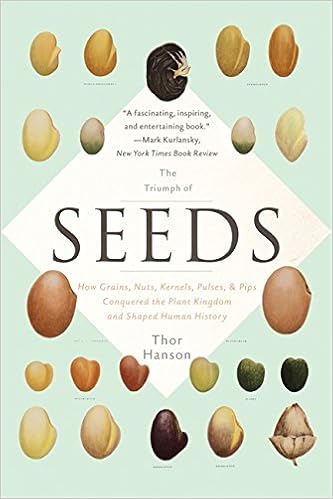
Reference: Hanson, Thor. The Triumph of Seeds: How Grains, Nuts, Kernels, Pulses & Pips Conquered the Plant Kingdom and Shaped Human History. Basic Books, 2015. (P. xix-18, 55-80)
 https://images-na.ssl-images-amazon.com/images/I/41YojAxCKHL._SX331_BO1,204,203,200_.jpg
The frustration of nut cracking is real. I enjoyed the imagery Hanson gave when he described his
unsuccessful attempt to split open a seed in his office, and his description of the professor who stormed in, angry with the noise. I found it funny that after all the ruckus he created, a spark of interest grabbed his attention: "why would a seed's shell be so impossibly hard to split? (xx). It is amazing that plant seeds have evolved to be so hardy. Seeds have made an impact in the history of human kind. as Hanson mentions, Homo sapiens may have not evolved if we had no seeds. why? They paved the way to modern civilization, with food, economies, and lifestyle around the world (xxii).
Seeds nourish, unite, endure, defend and travel. Seeds are and integral part of the world (xxv). They are all around us and play an important role in the survival of most all species on this planet.
The first chapter of this book is seriously engaging. I love how we get to walk in the jungle, experiencing Hanson's senses. We have the opportunity to dive into his mind and grasp all of his questions about seeds. Which brings us to the avocado, the humongous seed that shows every detail of germination at close up. The baby plant in a box with a lunch analogy helps me better understand the basic elements of a seed. Carol, a seed biologist explains that an avocado seed constantly needs water or to be moist otherwise it will die, unlike other seed embryos which will slow to near a standstill, then persist when water is available. I found this most interesting about the avocado.
I find it amazing that avocados do not need any extra fertilizer because the seeds food storage is so rich with nutrients that extra fertilizer is only needed past the seedling stage. This seed is entirely self sufficient.
Seeds Unite (p.55-80)
"When spore plants have sex, they usually do it in dark, wet places, and quiet often with themselves"(63). This posed as a problem when the Carboniferous started to dry up. As a result seeds evolved in response to the limitation of spores. The fossil record for seed evolution remains hazy (66); however, spike mosses and other plants fill the gaps. For instance, the spike mosses separated their sexes allowing for genetic variability, and allowed the plant to start carrying a packed lunch (66). Hanson describes the last evolutionary step in seeds as the drive to cover up for protection. Not only for protection but to attract animals (colorful fruit) for seed dispersal. I think that this evolutionary drive is so fascinating. Plants have been manipulating animals with their pretty flowers and fruit so they can survive, and take over as much area as they can.
Chapter five on Mendel's peas is an important chapter. not only is Mendel an important contributor to genetics, but his experiments show "how profoundly seeds, and our intimate relationship with them, have influences the way we understand the natural world"(73). Mendel's experiments with the peas has lead to the discovery of genetics and equally supports evolution. Mendel uncovered many mysteries; however, there are many more questions that scientists have been asking themselves and their colleges, we have only barely scratched the surface.
Reference: Hanson, Thor. The Triumph of Seeds: How Grains, Nuts, Kernels, Pulses & Pips Conquered the Plant Kingdom and Shaped Human History. Basic Books, 2015. (P. xix-18, 55-80)
Comments
Post a Comment