The Botany of Desire: xiii-xxv. (introduction: The Human Bumblebee)

Michael Pollan raises some serious questions while working in his garden, planting his potatoes. Are humans like bumblebees? Did we co-evolve with plants as bees have? Bumblebees and plants have this trade-off: flowers provide the bee with food and the bee spreads that plant's genetics around. "All those plants care about is what every being cares about on the most basic genetic level: making more copies of itself"(xv). Pollan asks himself: "did I choose to plant these potatoes or did the plant make me do it?"(xv). I thought this question was interesting, as a matter of fact I thought to myself: "yea?! who the heck is controlling who here?" I found it interesting that Pollan describes the plants we most rely on as plants that have been "going about the business of re-making us"(xvii). I found this interesting because he is absolutely right about that, these plants are dictating what we eat, and how we go about with our lives. We do not give plants enough credit on how amazing they actually are.
Pollan's ideas of human desires relating to plants, convinced me to realize that we in fact do use these plants for our own desires, and it has shaped our history and cultures. Pollan brings up Charles Darwin and the ideas of artificial selection and how it is not at all artificial at all, it is in fact the same as natural selection. These two forms of selection still follow evolutionary rules, the only difference is that artificial selection is driven and "reflecting human will"(xxii). I am excited to continue reading this book and learn the stories of the plants Pollan has chosen (apple, tulip, cannabis, and potato) to explain the way plants have shaped our species.
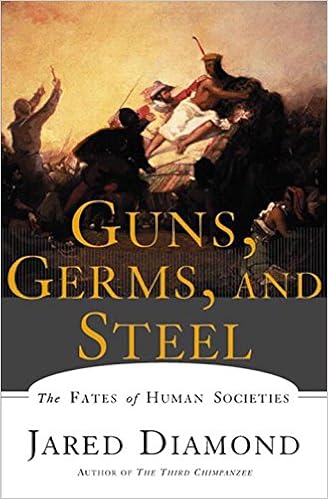
Guns, Germs, and Steel: Ch.7 (How to Make an almond)

I find it amazing that plants have adapted to use animals as a method of seed dispersal. They have evolved to make us attracted to them, so we pick them and eat them. They use us to increase their fitness. "It may come to a surprise to learn that plant seeds can resist digestion by your gut and nonetheless germinates out of your feces. But any adventurous readers who are not too squeemish can make the test and prove it for themselves"(116). I laughed out loud when I read this; however, it is also truly amazing that seeds are so resistant to the digestive process in an animal that when it comes out the other end it has the opportunity to establish itself in another area of the land (or wherever an animal decides to poop). Agriculture was first established by how available and desirable plants and seeds were, "curious children of early farmers, nibbling wild plants around them, would eventually have sampled and noticed those nonbitter almond trees"(118); as a result, "Those nonbitter almond seeds are the only ones that ancient farmers would have planted"(118). With farmers solely planting nonbitter almond trees, the plant underwent domestication and became edible. The evolution of wild plants has been a result of human cultivation, humans selected and collected seed that had bigger fruits, were the easiest to pick, or oilier. Horticulture and artificial selection over human history has been an important model for us to understand natural selection. Pollan brings up the first chapter in Darwin's book The Origin of Species, Darwin started his book off with artificial selection and how humans have played a role in evolution so we can better understand the role of natural selection in the evolution of wild plants to domesticated plants.
References:
Pollan, Michael. 2001. The botany of desire: A plant's-eye view of the world. New York: Random House.

Diamond, Jared. 1997. Guns, germs, and steel: The fated of human societies. New York: W.W. Norton and Company.
bumblebee picture: https://floristupmystreet.co.uk/flower-news/wp-content/uploads/2017/04/White_Tailed_BBCT_3_RS_550_332.jpg
almond picture: http://www.nationalalmondday.com/uploads/1/0/8/5/10858300/7616900.jpg?384
botany of desire cover: https://images-na.ssl-images-amazon.com/images/I/51NZ3hCsYVL._SX321_BO1,204,203,200_.jpg
guns, germs, and steel cover: https://images-na.ssl-images-amazon.com/images/I/51LVx6UrW5L._SX326_BO1,204,203,200_.jpg
I was intrigued to read your blog after we spoke in Save On Foods today. Monica you have some great ideas! I thought exactly some of the same things while reading.
ReplyDelete