To Farm or Not to Farm
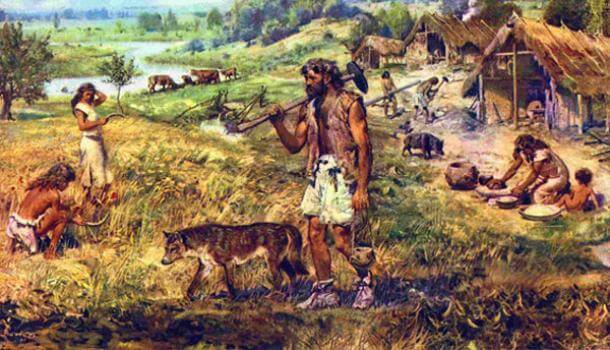


"That strength of brute numbers was the first of many military advantages that food-producing tribes had gained over hunter-gatherer tribes" (88). The shift from humans being hunter gatherers to farmers has changed human civilization dramatically. I found it very interesting when Diamond explained that in hunter-gatherer societies there is a lengthened birth interval because tribes were constantly on the move, "she cannot afford to bear her next child until the previous toddler can walk" (89). After the establishment of agriculture, birthrates increased and higher population densities occurred in farming communities than in hunter-gatherer tribes. Interestingly, shortly after crops and animal husbandry was established, new discoveries of plant and animal fibers such as cotton and wool were used for clothing; however, humans who "domesticated animals were the first to fall victim to newly evolved germs"(92) and diseases.
I find it interesting that with the beginning of the first people cultivating plants, agriculture took off at exponential rates and an abrupt increase of human populations occurred. However, some areas of the world were more suitable than others for agriculture, and as a result hunter-gatherer societies remained in some areas for much longer because there was no need to cultivate plants and domesticate animals.
"Nasty, brutish and short"(104). This is what the lifestyle of the hunter-gatherers is described as. Looking at evidence of early farming it is noted that early agriculture was a lot of work, and as a result tribes that farmed were more susceptible to disease and obtained less nutrition than the hunter-gatherers. All that aside, Diamond reminds us that the shift from hunter-gatherer to food production systems was a result of " the accumulation of many separate decisions about allocating time an effort"(107). Diamond explains that "human and animal foragers are constantly prioritizing and making effort-allocation decisions, even if only unconsciously" (107). we are constantly looking for the highest payoff. We have to meet our caloric needs in the easiest possible way, and fast in order to survive. MacDonalds anyone? Farming allowed us to produced food in large quantities and with a high payoff, we had to work hard to cultivate and raise our food; however, we were also able to store food for later. As a result, we had a higher payoff. we did not have to work so hard to find or hunt every meal like the hunter-gatherers did.
It took a long time to kick-start farming in most fertile areas. This was probably because of the lack of availability of wild plants that could be domesticated. The difficulty in domesticating plants is that not very many produce enough yield to sustain enough food production to support transitioning hunter-gatherer cultures. It would take a huge effort to find the appropriate plants to be domesticated.
References
Book: Diamond, Jared. 1997. Guns, germs, and steel: The fated of human societies. New York: W.W. Norton and Company.
top picture: https://geneticliteracyproject.org/wp-content/uploads/2015/04/neolithic-farmers.jpg
second picture down: https://cdn.thinglink.me/api/image/712030302003789824/1240/10/scaletowidth
third picture down: https://blogger.googleusercontent.com/img/b/R29vZ2xl/AVvXsEgIvOf9gvm1kpw5BpvGTLO_n0S53w7yLwsI43vhN8EswEQvkTt9It57Pk3yye1slJtf0_eg7Ft-U6X1-AJ5MMrhICmjZc9nnJ4TK1QYhFdiv8w_jhNh_hAVY1rPGmJZw1HPVbm9L4twfgA/s1600/farms+1+.jpg
bottom picture: https://static.agcanada.com/wp-content/uploads/sites/3/2014/10/combines_lineup_thinkstock_-e1413996211836.jpg
I also found it pretty interesting on how the hunter gatherers remained as such in the places that seemed more suitable for farming and cultivating plants. I really liked how you started your blog off too. It was a good, strong quote and had me pretty interested in reading the rest of your thoughts.
ReplyDeleteMacDonalds anyone ->Very Clever! Your articulation of the meaning behind Diamond's writing was interesting to read. You managed to summarize the topic of agricultural development and make it something fun. Great read!
ReplyDelete