
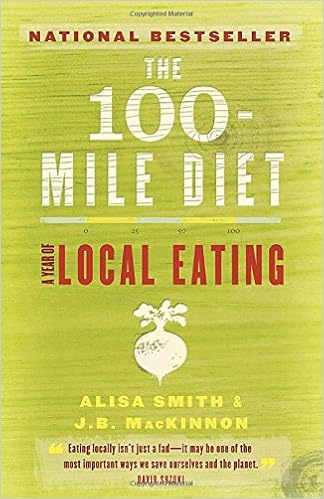
The 100-mile diet by Alisa Smith and James MacKinnon is a thoughtful book that astonishes its readers on the harsh reality of how detached people are from nature and the knowledge of where their food comes from. These authors have planted a seed that has enlightened their community, province and country. The authors spark a realization of the importance of eating local. I enjoyed how this book starts with Alicia and James cooking a meal from vegetables grown in a garden at their eighty year old Cabin in Northern B.C. It is like going back in time, showing how closely connected people are with nature when living a rural life, and being self-sufficient. Back at their home in Vancouver, where the authors primarily reside Alisa steps inside of a grocery store for the first time after her and her husband decide to start their 100-mile diet. They are shocked at how little of the food on the shelves is local. They realize how insane it is that most of our food is from all over the world and in order for our food to get to us, fossil fuels are are constantly being emitted far more than they would if we ate local. "The explanation for long-distance eating is cheap oil" (p.30).
I enjoyed reading the book in both Alicia's point of view and James's, each chapter alternates point of view. They both have different perspectives and personal challenges on eating local. I found their backgrounds very intriguing as well. They were both brought up differently. I found it interesting how they would have flashbacks about when their parents and grandparents cooked or grew food themselves.
"It is no secret that we, as a society, have been losing the traceablility not only of our food, but every aspect of our lives"(p.55). I found this sentence very meaningful. James goes on in this chapter to explain that he will probably never meet the people who made his shoes, and that in a community that he has lived for nearly five years, he does not know the names of his neighbors. James makes a good point that there has been a loss in connection to food and the places it comes from. In the 1920's half the population of Canada and the US lived on farms and half lived in the cities, people were self sufficient. Now, people don't even know what a cow looks like.
The mouse poo in the wheat was pretty funny. I love how bad both Alicia and James wanted flour for bread or pancakes. Their cravings resulted in getting a pail of wheat from a farmer in Delta only to be later separating mouse turds from the wheat berries.
"Everyone who eats meat should have to keep livestock"(p.73). I completely agree with Alisa on this one. People who eat meat should understand the process of raising an animal, caring for that animal, butchering that animal, and preparing it for the table. It is a long, hard process that consumers take for granted. Like mentioned in the book, in the past more than half the population raised their own food. Over time, society has lost that connection to nature and as a result the knowledge on food growth. All consumers know is the inside of a grocery store and their microwave. How sad. How sad that we have lost our knowledge and relationship with nature.
Growing up on my parents farm I have been lucky enough to have a 500 meter diet my entire life. Even the silly deer that would foolishly steal apples every morning in the orchard behind the house met the barrel of my mother's .270 and ended up on our plates, along with the carrots, potatoes, and kale from our garden. It is not that hard to grow food, skin and gut a deer, or weed a garden while the sun is beating down your back, or harvest veggies and fruit. It just takes a little effort. As a matter of fact it absolutely exciting and makes you feel proud of yourself. Going into a grocery store and picking out a package of meat or carrots from the produce section does not have that same effect.
Overall I thought this book was fantastic. It is a wake up call to all of us. The statistics mentioned in this book are staggering and it should be enough for us to start changing the way we eat to save ourselves and the planet.
Reference: Smith. A, MacKinnon. J. (2007). The 100-Mile Diet. Toronto Ontarion: Random House.
https://images-na.ssl-images-amazon.com/images/I/51jJJ8oe7sL._SX322_BO1,204,203,200_.jpg
Comments
Post a Comment